Louvers are key architectural elements that change how your building works and looks. They control airflow, manage light, and add visual appeal inside and out. Investing in the right louvers brings many benefits to your building.
Architectural louvers do more than just ventilate. They boost energy efficiency, protect against weather, and improve security. You need a louver system that fits your building’s design and needs.
Choosing louvers wisely can transform your building. Exterior louvers protect your building, while interior louvers improve air quality and space. These solutions are great for commercial, residential, and industrial projects across the U.S.
This guide shows seven ways louvers can enhance your building. You’ll learn about custom sizing, ventilation, health benefits, blade selection, weather protection, security, and aesthetics. Each area offers significant value for your investment.
Your building needs louver solutions that work well. Standard options may not be enough. Finding solutions that meet your building’s needs can lead to real change.
Key Takeaways
- Louvers control airflow and reduce strain on your HVAC system
- Architectural louvers protect your building from storms and weather damage
- Exterior louvers and interior louvers enhance both function and aesthetics
- Custom louver systems align with your specific project requirements
- Security louvers provide blast-resistant protection for your building
- Building transformation combines ventilation, health, and design improvements
- Louver selection impacts energy costs and occupant comfort
Why Louvers Are Essential Architectural Elements for Modern Buildings
Louvers are more than just window coverings or vents. They are key design elements in modern buildings. They help manage light, airflow, and look great. These features are vital in homes and businesses across the U.S.
Knowing how louvers work helps in choosing the right ones for your project. They fit well into building designs, adding beauty and function. They help define spaces and set the look of your property’s inside and outside.
Defining Louvers and Their Functional Purpose
Louvers are made of slats or blades in a frame. They offer many benefits. They let in air and light, but block out direct sunlight, rain, and unwanted views. They help control ventilation, privacy, temperature, and protect against weather.
Think of louvers as smart barriers. They control light, improve airflow, and offer privacy. They help keep your building cool and protect it from the elements.
| Louver Function | Building Benefit | Performance Impact |
|---|---|---|
| Light Control | Reduced solar heat gain and glare | Lower cooling costs year-round |
| Airflow Management | Improved indoor air circulation | Enhanced occupant comfort levels |
| Privacy Protection | Visual barriers between spaces | Increased security and comfort |
| Weather Defense | Rain and wind deflection | Reduced water damage risk |
| Aesthetic Appeal | Visual interest and character | Enhanced property value |
The Evolution of Louver Design in Contemporary Architecture
Louver design has changed a lot in recent years. Early designs were simple wooden slats for ventilation. Now, you can find advanced systems made from materials like aluminum and composite blends. These modern louvers can adjust automatically and work with smart building systems.
The change from basic to advanced designs marks a big step in architecture. Today, louvers are key features that define buildings. They add beauty while controlling the environment. Architects see louvers as essential for combining function and style in buildings.
Achieving the Perfect Size and Custom Fit for Your Project
Standard louvers are available in many sizes and types. But, your project might need something special. Custom louvers let you create ventilation that fits your exact needs. Design teams can make louvers that match your project’s details perfectly.
Louver size is key to good ventilation. A perfect fit means your louvers work well with your building. They fit snugly without gaps or overhangs.
Your custom fabrication team will measure your openings carefully. They make sure every detail matches your vision.
Understanding Your Measurement Requirements
Custom louvers need accurate measurements. You need to know the height, width, depth, and frame size. These details help your louvers work well once installed.
Project specs guide the custom fabrication process. Taking time to document these details helps avoid costly changes later.
| Measurement Type | Why It Matters | Impact on Installation |
|---|---|---|
| Opening Height | Determines louver blade length and overall unit height | Ensures proper coverage and aesthetic alignment |
| Opening Width | Defines louver frame width and structural support | Prevents gaps and maintains weather protection |
| Frame Depth | Accommodates mechanical components and airflow paths | Reduces installation time and field adjustments |
| Tolerance Levels | Allows for minor construction variances | Guarantees precise fit without forcing components |
Investing in Custom Fabrication for Long-Term Value
Custom louvers cost more upfront than standard ones. But, they save time and money in the long run. They fit perfectly without needing costly changes.
Working with your design team ensures your project gets what it needs. Custom louvers offer a fit that standard options can’t match.
Optimizing Airflow and Ventilation Throughout Your Building
Your building’s performance is tied to how well you manage airflow and ventilation. Installing louvers helps fresh air move naturally through your structure. This natural flow reduces the load on your mechanical systems and cuts costs.
Proper ventilation systems work with your HVAC to keep everyone comfortable all year. This balance is key to a happy and healthy indoor environment.
Louvers act as passive ventilation, working alongside your HVAC. They help keep your building cool in summer and improve air flow in winter. This boosts your HVAC’s efficiency.
How Louvers Reduce HVAC System Strain and Energy Costs
Your HVAC systems work harder without good ventilation. Louvers bring in fresh air, making your indoor space more comfortable. In spring and fall, they let you cool your building naturally, saving energy.
Buildings with better ventilation systems use 15 to 30 percent less energy for ventilation. This means your HVAC lasts longer, saving on maintenance and extending its life. Investing in affordable privacy fin louvers is a smart move for long-term savings.
| Building Type | Annual Energy Savings | Equipment Lifespan Extension |
|---|---|---|
| Commercial Office | 18-28% | 3-5 years longer |
| Industrial Warehouse | 20-30% | 4-6 years longer |
| Residential Building | 15-22% | 2-4 years longer |
Preventing Condensation and Moisture Damage
Moisture is a big problem for buildings, like steel ones and warehouses. It forms when warm, humid air meets cold surfaces without air flow. Your ventilation systems stop this by moving air constantly.
Strategic louver placement helps control moisture. This prevents damage and saves you money. It keeps your building safe and healthy for everyone inside.
Enhancing Indoor Air Quality and Occupant Health
You spend about 90% of your time indoors. The air you breathe often has more pollutants than outside air. This makes indoor air quality very important for your building’s occupants.
Poor air circulation inside can trap harmful chemicals. These come from paints, cleaning products, and furniture. Without good ventilation, these chemicals build up, making the air unhealthy for everyone.
Louvers help bring in fresh air into your building. They let outdoor air flow through to air handlers. This keeps the air inside clean and reduces CO2 levels.
This air exchange helps prevent mold and mildew. Without proper air flow, moisture can cause these problems. This is bad for your health.
Louvers are key to a healthy building. They work well with your HVAC system. This means your air stays clean and your system works better.
Choosing the right louvers is important. They should have low pressure drop and high free area. This helps your system work efficiently. By using AMCA-certified louvers, you’re making your building healthier and more durable.
Better indoor air quality means healthier occupants. You’ll see less respiratory problems, allergies, and brain fog. Meeting LEED and WELL Building Standards becomes easier too.
| Air Quality Factor | Impact on Occupant Health | Louver Solution |
|---|---|---|
| Volatile Organic Compounds (VOCs) | Respiratory irritation and headaches | Fresh air intake reduces VOC concentration |
| Carbon Dioxide Buildup | Cognitive impairment and fatigue | Continuous air circulation prevents CO2 accumulation |
| Mold and Mildew Growth | Allergic reactions and respiratory issues | Proper air circulation eliminates moisture |
| Allergens and Dust Particles | Allergic responses and asthma triggers | Air circulation dilutes indoor pollutants |
| Stagnant Air Conditions | Sick building syndrome | Louvers enable consistent fresh air delivery |
Selecting the Right Blade Type for Maximum Performance
Your building’s ventilation depends on the right louver blade choice. The design of louver blades impacts airflow, weather protection, and security. Knowing the difference between fixed and adjustable louvers helps you pick the best for your needs.
Fixed Louvers vs. Adjustable Louvers: Understanding the Differences
Fixed louvers stay at a set angle, between 35 and 45 degrees. This design offers steady airflow with little need for adjustments. Your building performs well all year with less upkeep.
Adjustable louvers offer more flexibility. They can move from fully closed to 90 degrees open. This allows for better airflow control, adapting to changing weather and seasons.
| Feature | Fixed Louvers | Adjustable Louvers |
|---|---|---|
| Blade Angle Range | 35-45 degrees fixed | 0-90 degrees adjustable |
| Maintenance Requirements | Minimal moving parts | Periodic lubrication needed |
| Airflow Capacity | Moderate, consistent | Maximum when fully open |
| Weather Protection | Balanced defense | Adjustable protection levels |
| Initial Cost | Lower investment | Higher upfront expense |
Controlling Airflow from a Single Access Point
Adjustable louver systems often have a central control. This lets you manage many louver banks from one spot. It saves time and cuts down on maintenance costs.
Choosing between fixed and adjustable louvers impacts your building’s ventilation for years. Your decision affects its performance.
Storm Resistance and Weather Protection Capabilities
Your building faces threats from severe weather. Whether you live on the Atlantic coast, the Gulf Coast, or anywhere storms hit hard, you need strong louvers. Storm-resistant louvers keep rain and wind-driven moisture out, protecting your building.
Different louver models offer varying weather protection. Some handle light rain and moderate winds. Premium options provide 100% rain defense in extreme conditions. Your choice depends on your location and the storms it faces.
Hurricane-rated louvers meet strict engineering standards for high-wind regions. They use advanced blade geometry, drip edges, and sealing technology to block water. The Air Movement and Control Association (AMCA) tests louvers at different wind velocities to measure their rain defense capabilities.
| Louver Protection Level | Wind Speed Range | Rain Defense Rating | Best For |
|---|---|---|---|
| Standard Weather Protection | Up to 60 mph | Partial (85-90%) | Inland areas with mild storms |
| Enhanced Wind Resistance | 60-120 mph | High (95%+) | Coastal regions and tornado zones |
| Hurricane-Rated Louvers | Over 150 mph | Complete (100%) | Hurricane-prone coastal areas |
Storm-resistant louvers direct water away from openings through intelligent design. Labyrinth sealing systems create barriers that trap water before it enters your building. Baffles slow wind-driven rain, reducing its force against internal surfaces.
Your building codes require specific wind resistance ratings depending on your location. Hurricane-rated louvers meet or exceed these local standards. When you specify louvers for your project, request AMCA performance data. This documentation proves your system delivers the weather protection your building needs.
Louvers as Security Features and Blast-Resistant Solutions
Your building’s safety relies on many layers of protection. Security louvers are a key part that many overlook. They keep your building safe while also letting in air. Government and corporate buildings use these louvers to protect their spaces.
Knowing how security louvers work helps you choose the right ones. They are made stronger than regular louvers. They stop intruders and let air in, keeping your building safe.
Aluminum Louvers for Enhanced Building Security
Aluminum louvers are top choice for security. They are strong but light, hard to cut or pry. They also don’t catch fire, adding to your building’s safety.
These louvers have thicker blades than usual. They have strong frames and fasteners that can’t be tampered with. They meet high standards for government buildings.
Blast-resistant louvers are the most protective. They can handle big blasts. They keep your building safe from explosions, protecting people and things inside.
| Louver Type | Blade Thickness | Primary Application | Blast Load Rating | Material Benefit |
|---|---|---|---|---|
| Standard Commercial | 0.050″ | General ventilation | Not rated | Cost-effective |
| Security Grade Aluminum | 0.125″ – 0.25″ | Forced entry protection | Not rated | Corrosion resistant |
| Blast-Resistant Aluminum | 0.25″ | Federal buildings, embassies | Up to 12 PSI | Non-combustible |
| Military-Grade Aluminum | 0.25″+ | Military installations, critical utilities | Exceeds 12 PSI | Highest strength-to-weight ratio |
Use aluminum louvers for your building’s security. They fit well with your building’s safety plan. Installing blast-resistant louvers shows you care about keeping people and things safe.
When picking security louvers, work with experts who know what’s needed. Your building can stay well-ventilated and safe with the right louvers.
Creating Visual Barriers and Defining Interior Spaces
Interior louvers are great for dividing large areas without solid walls. They help create different zones while keeping things open and connected. These louvers are perfect for modern offices, lofts, and commercial spaces where flexibility is key.
Unlike solid walls, louvers let light and air move freely. This makes your space feel airy and open, yet defined. They’re a smart choice for creating separate areas without losing the sense of openness.
Visual screens made from louver panels are powerful design tools. Stand-alone panels can mark a welcoming area at entry points. They separate spaces without blocking views, making them ideal for offices, restaurants, and hotels.
Interior louver wall designs can be feature walls or room dividers. They turn plain surfaces into focal points while keeping spaces connected.
Horizontal wooden louvers create calm, open zones. Vertical panels add height and sophistication. Adjustable panels offer flexibility, opening for teamwork or closing for privacy.
Acoustic louvers control sound, perfect for spaces needing both openness and quiet. Your choice of material affects the look and feel. Wood adds warmth and natural sound, while aluminum is modern and durable.
| Louver Type | Best Interior Application | Key Benefit | Material Options |
|---|---|---|---|
| Horizontal Louvers | Open-plan offices, residential living areas | Creates calm, spacious feeling | Wood, aluminum, PVC |
| Vertical Louver Panels | Reception areas, commercial entrances | Adds height and visual interest | Wood, powder-coated aluminum, composite |
| Adjustable Louvers | Meeting rooms, restaurant sections | Flexible privacy control | Aluminum, wood with mechanical systems |
| Acoustic Louvers | Healthcare facilities, educational buildings | Sound absorption and noise control | Specialized acoustic materials, wood composite |
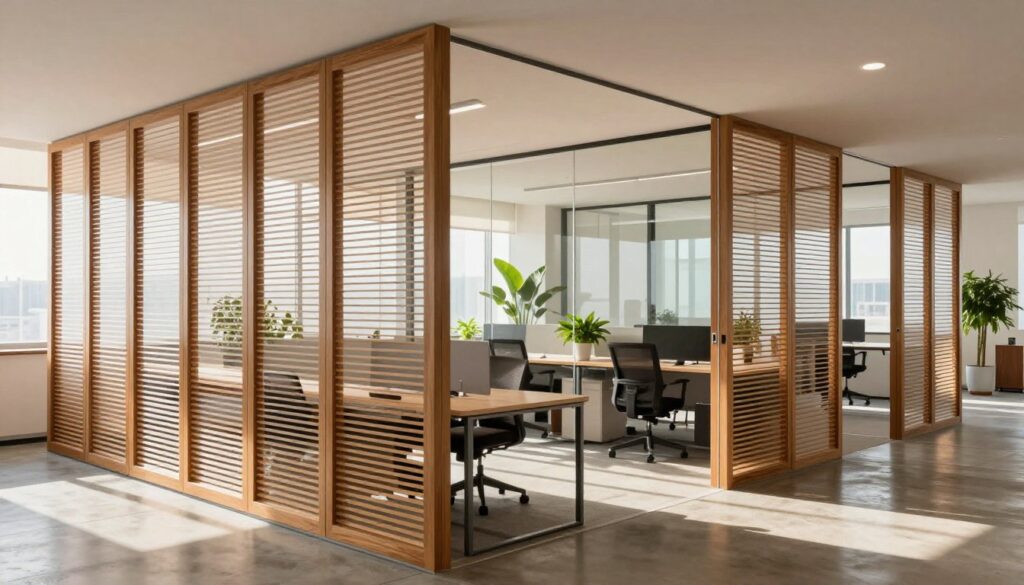
Space dividers don’t have to be industrial or cold. Modern design uses louver screens as stylish elements. Choose decorative patterns to make dividers into visual statements.
Backlit louvers create striking feature walls. They define areas and add dramatic lighting. In homes or workplaces, these screens keep zones connected while providing privacy and sound control.
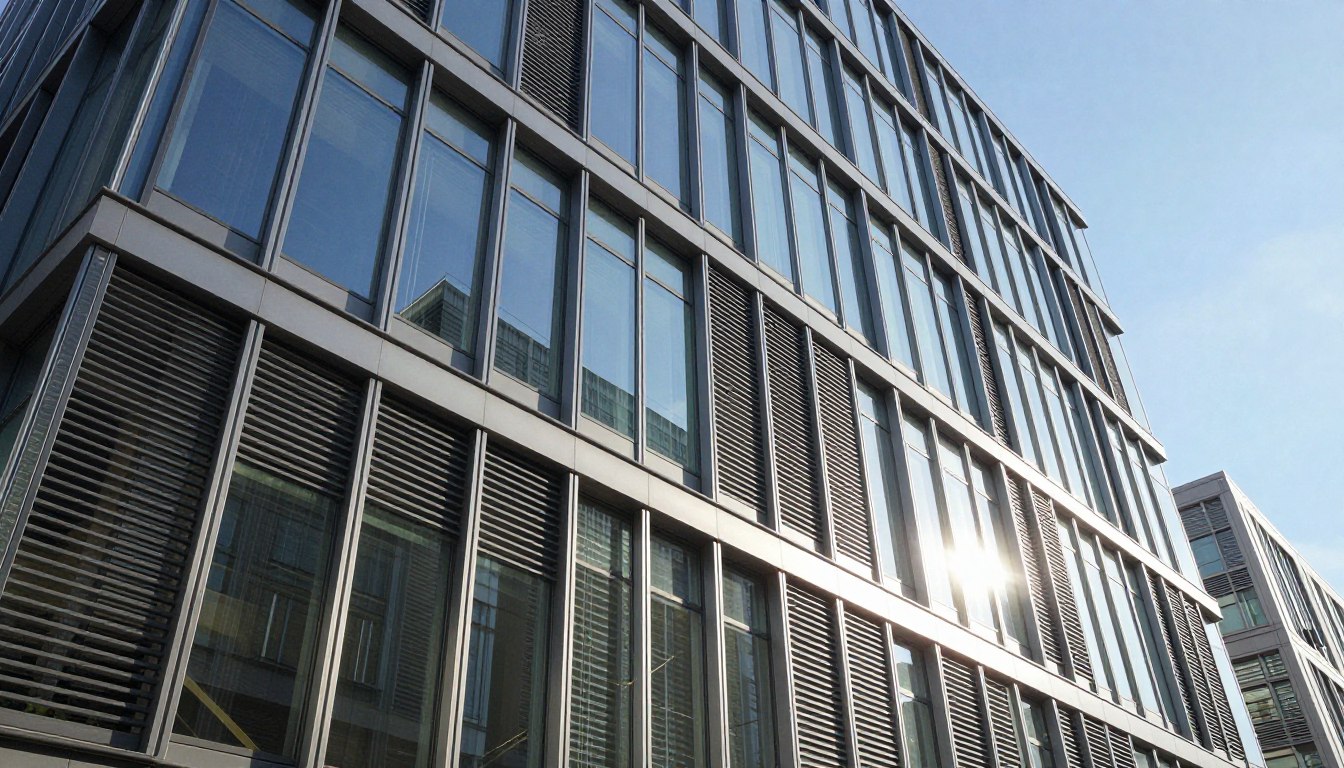
Transforming Building Facades with Dynamic Louver Systems
Your building’s exterior can become more than just a surface. Dynamic facades turn it into something extraordinary. They combine function with beauty, making your property stand out.
Facade louvers change how your building looks and works all day. These systems make exteriors alive, reacting to light and weather. They’re a new way to see buildings.
Modern buildings use louver systems to show off their unique look. The exterior gets depth and character from these systems. Shadows move, adding interest from every view and time.
Using Louvers as Architectural Focal Points
Dynamic facades catch the eye with smart louver placement. Louvers create a rhythm on the building’s face. You can highlight areas by changing how many louvers are there.
Make some louvers pop by using different materials or colors. Options like aluminum, metal, wood, glass, and vinyl add style. This makes your building unique, great for offices and fancy homes.
Incorporating Rotating and Adjustable Facade Elements
Advanced louver systems adjust to your needs. They move with the sun to save energy. People can also change them to fit their needs.
| Louver System Type | Primary Function | Best Application |
|---|---|---|
| Automated Rotating Louvers | Solar tracking and climate control | Modern commercial buildings |
| Manual Adjustable Louvers | User-controlled shading | Office and residential spaces |
| Fixed Architectural Louvers | Visual design and ventilation | Structural facades |
| Kinetic Facade Louvers | Movement-based aesthetics | Landmark buildings |
Kinetic facades show off moving louvers for a changing look. Your building becomes a moving art piece. It grabs attention day and night. Making sure it works well for years is key.
Customizing Aesthetics with Colors, Textures, and Materials
Your building’s look is important. Custom louvers let you pick the perfect style for your project. You can choose from louvers that stand out or those that blend in.
Louver materials range from natural wood to aluminum to composite blends. Each offers unique looks that fit your design.
The right louver materials set the tone for your exterior. Natural wood adds warmth to any design. Aluminum offers modern lines and lots of color choices.
Bronze finishes give a prestigious look, perfect for heritage buildings. Composite materials look like wood but need little maintenance, great for busy spaces.
Your color choices affect how people see your building. You have many powder coat finishes to choose from. Custom color matching ensures your louvers match your brand or design.
Anodized finishes add a metallic look that changes with light. Bold contrasting louvers make a statement. Tone-on-tone approaches add subtle elegance.
| Louver Material | Visual Characteristics | Maintenance Level | Best Applications |
|---|---|---|---|
| Natural Wood | Warm, organic texture | High | Traditional, rustic designs |
| Aluminum | Clean lines, modern appeal | Low | Contemporary commercial buildings |
| Bronze | Prestigious, refined finish | Medium | Heritage and upscale properties |
| Composite | Wood-grain appearance | Very Low | High-traffic commercial areas |
Texture choices affect both look and durability. Smooth finishes are sleek and modern. Textured surfaces hide fingerprints and weathering.
Wood grain patterns in composite materials look authentic without the upkeep of natural wood. Perforated blade options add interest while keeping function. Weathered or patina finishes develop character over time in different climates.
Your architectural finishes impact long-term look. Consider the climate when choosing finishes. Metallic finishes reflect light, while matte finishes reduce glare.
Your design choices, along with louver materials, create cohesive exteriors. These exteriors can stand out or blend in, based on your preference.
Integrating Louvers into Outdoor Living Areas and Roof Systems
Expanding your living space outdoors opens up new possibilities for comfort and style. Outdoor louvers bring sophisticated climate control to patios, decks, and garden areas. They transform your backyard experience while keeping your home’s architectural elegance intact.
Roof louvers make outdoor entertaining flexible. They let in natural light and keep the air fresh when open. Closing them protects guests and furniture from rain and intense sun. This way, you can enjoy your outdoor space all year without a fixed roof.
Pergola louvers have rotating blades that adjust like sunglasses for your yard. You can control the angle for perfect sun and shade balance. They adapt to your needs, keeping your space comfortable without blocking breezes.
Privacy walls with outdoor louvers create boundaries around pools and entertainment areas. Unlike solid fencing, these screens maintain airflow while blocking views. You get both seclusion and fresh air at the same time.
| System Type | Best Use | Key Benefit | Material Choice |
|---|---|---|---|
| Roof louvers | Patios and decks | Weather protection and light control | Marine-grade aluminum |
| Pergola louvers | Garden seating areas | Rotating sun and shade adjustment | Powder-coated aluminum |
| Vertical louvers | Privacy screening | Maintains airflow with seclusion | Treated wood or aluminum |
| Automated systems | Multi-zone outdoor spaces | Rain sensors close for protection | UV-resistant finishes |
Choosing the right material is key for outdoor use. Coastal areas benefit from marine-grade aluminum. Inland areas can opt for treated wood for a natural look. Powder-coated finishes resist UV damage, keeping your louvers looking good for years.
Automated roof louvers with rain sensors add convenience to outdoor living. They close automatically when it rains, protecting your seating areas. You can relax with family and friends without worrying about the weather. Your outdoor spaces work together seamlessly, extending your living area all year.
Conclusion
Your building needs more than just basic louvers. Standard sizes limit what you can achieve. Custom solutions let you design exactly what you need.
Whether it’s precise dimensions or unique looks, you have endless options. Working with skilled manufacturers makes your vision a reality.
The seven strategies mentioned in this article work together. Each louver location can tackle many goals at once. Your choice of louvers affects everything from air flow to looks and costs.
This investment improves your building in many ways. Think of louvers as key systems that boost your property’s value over time.
Starting your louver project is easy. Just list what you need, like size, performance, and style. Contact top louver makers like Duco to turn your ideas into real solutions.
They’ll give you detailed plans for materials, finishes, and how to install them. Choosing the right louvers means you get exactly what you need, not something that doesn’t fit.
Your building upgrade is just beginning. Tell experienced louver makers about your project, and they’ll create custom louvers for you. You’ll find the perfect match for your project. This shows your building’s true worth and your dedication to quality.