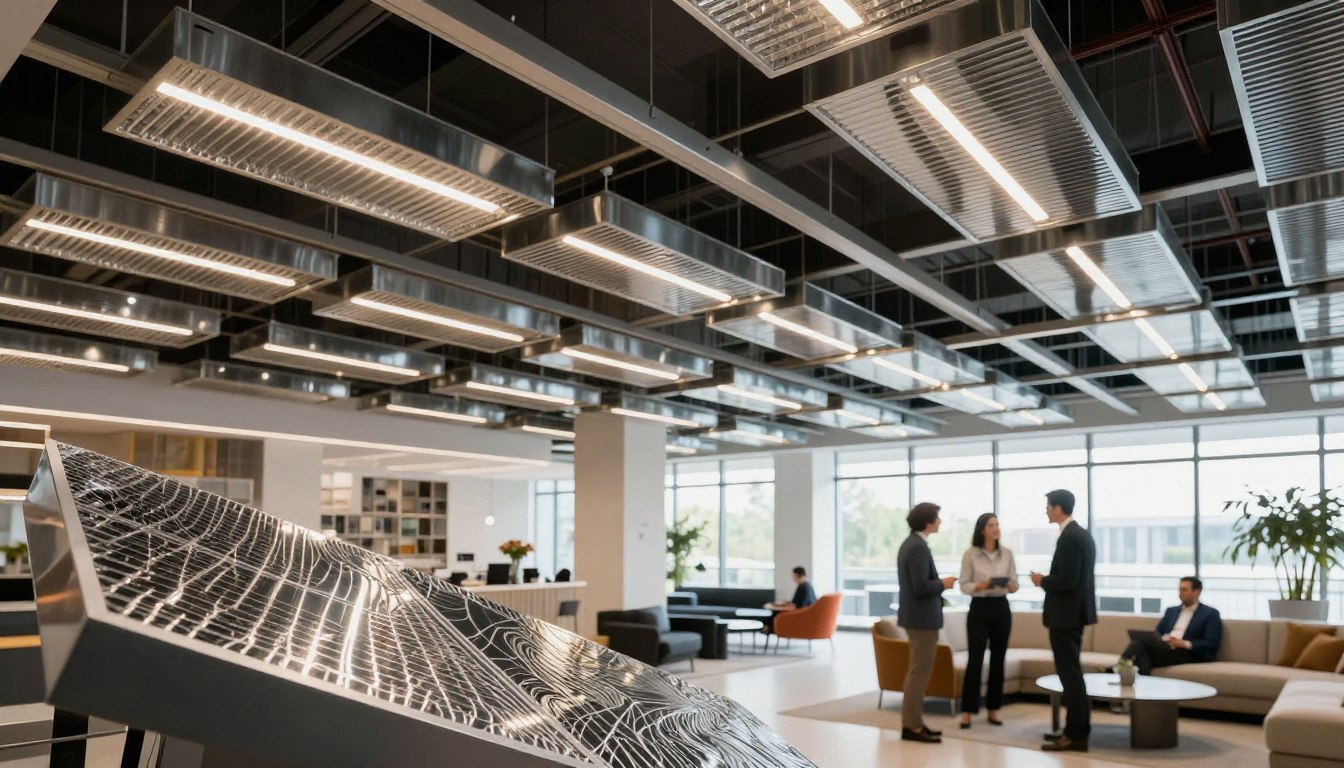
Metal baffle systems offer top-notch sound quality and a sleek look. They turn regular spaces into unique places. These systems also hide unsightly infrastructure, making your building look modern and clean.
Installing metal baffle ceilings brings many benefits. They last a long time and need little upkeep. This means you’ll save money on maintenance. Plus, they let air flow freely, which saves energy.
When planning a renovation or building a new place, think about the cost-benefit. Metal baffle systems save money in the long run. They make your space look and sound better, making everyone happier. This leads to a more polished environment.
This guide covers everything you need to know. You’ll find out which materials are best for your project. You’ll see styles that fit your design. And you’ll learn how these systems work in offices, stores, and schools.
Key Takeaways
- Metal baffle systems deliver superior acoustics and distinctive visual design compared to traditional ceiling options
- These ceilings conceal mechanical, electrical, and plumbing systems while maintaining clean sight lines
- Long-term cost savings and reduced maintenance make metal baffles a smart investment for commercial and residential spaces
- Energy efficiency and enhanced occupant satisfaction justify the initial specification decision
- Material durability ensures your ceiling performs well for decades with minimal upkeep
- Design flexibility lets you create the exact aesthetic your project requires
- Multiple applications work in offices, retail, healthcare facilities, and educational institutions
What Are Metal Baffle Ceiling Systems and Why They Matter
Metal baffle ceiling systems are a modern take on overhead design. They are made of metal slats or panels hung from a frame. These systems add both function and style to your space.
They solve design challenges by improving acoustics and air circulation. Plus, they add a unique look that closed systems can’t match.
Understanding Baffle Ceiling Design and Construction
Metal baffle ceilings have parallel slats hung from above. You can arrange these slats in different ways to fit your design. The space between them affects how they look and work.
How they’re built lets them work with your building’s systems. They can hide HVAC, lighting, and electrical parts. The metal used is strong and meets fire safety rules. The frame keeps everything stable and secure.
Key Features That Set Baffle Ceilings Apart from Traditional Systems
Baffles offer a unique look with shadow lines and depth. They make your ceiling stand out as a design feature. The slats’ spacing creates changing shadows with the light.
Unlike solid ceilings, baffles let air flow, cutting HVAC costs by up to 20%. This makes your building more energy-efficient. It also reduces your environmental impact.
Baffles are different from acoustic tiles because they’re stylish and functional. They absorb sound and look great. This makes your space sound better without losing its modern look.
| Feature | Metal Baffles | Closed Tile Systems | Solid Ceilings |
|---|---|---|---|
| Visual Interest | Shadow lines and depth | Flat, uniform appearance | Flat surface only |
| Air Circulation | Passive airflow allowed | Blocks airflow | Blocks airflow |
| HVAC Efficiency | 20% load reduction possible | Standard loads | Standard loads |
| Sound Control | Absorption + design | Absorption only | Minimal absorption |
| Design Flexibility | Multiple finishes and angles | Limited options | Painting only |
How Metal Baffles Transform Commercial and Residential Spaces
Your office ceiling shows off your brand. Metal baffles can make any office look modern and professional. The design choices reflect your company’s values.
Retail spaces get a big boost from baffles. They turn ordinary stores into memorable places. Each design choice can enhance your brand and customer experience.
Institutional places feel more welcoming with baffles. Schools and hospitals look better and work better. Baffles improve acoustics and make spaces more inviting.
Materials Used in Metal Baffle Ceiling Systems
Choosing the right material for your metal baffle ceiling project affects both cost and performance. You can pick from aluminum, stainless steel, or titanium based on your budget, environment, and design needs. Each material has unique benefits that fit different project needs and long-term goals.
Aluminum is the top choice for metal baffle ceilings. It’s light, making installation simpler and cheaper. Aluminum also resists corrosion well, even in humid places. It passes ISO 9227 salt spray tests for over 1,000 hours, ensuring a 15+ year lifespan.
Aluminum offers various finishes. You can powder coat it for color, anodize for a metallic look, or use PVDF for weather protection. These options let you customize your ceiling while keeping the material safe.
Stainless steel is known for its durability and fire safety. It’s perfect for busy places and industrial settings, even though it costs more. Its long-lasting performance and fire safety ratings make it a top choice for many.
Titanium is a luxury choice for high-end projects. It’s strong, light, and has a unique look. Its beauty lasts without needing much finishing, though you can add anodizing or powder coating for extra style.
| Material | Weight | Corrosion Resistance | Service Life | Cost | Best Applications |
|---|---|---|---|---|---|
| Aluminum | Lightweight | Good (oxide layer) | 15+ years | Moderate | Offices, retail, coastal areas |
| Stainless Steel | Moderate | Excellent | 20+ years | High | Transportation hubs, industrial |
| Titanium | Very Light | Excellent | 25+ years | Premium | Luxury commercial, high-end hospitality |
Each material offers different finishes to match your style. PVDF coatings are great for harsh weather. Powder coating lets you choose from a wide range of colors. Anodizing gives a natural metallic look, and wood-look textures add warmth without the upkeep.
Choose your material based on your project’s needs, environment, and budget. Aluminum is best for coastal areas due to its corrosion resistance. Stainless steel is ideal for industrial settings because of its durability. For luxury, titanium’s unique look and performance are worth the investment.
Acoustic Performance Benefits of Metal Baffle Ceilings
Metal baffle ceiling systems control sound well, changing how noise moves in your spaces. Knowing how these systems work helps you pick the best one for your sound issues. They make rooms quieter and more comfortable, whether it’s a conference room or a busy office.
These systems are powerful because of their design and materials. Sound waves hit the metal and then get absorbed by materials behind it. This reduces echoes and unwanted noise. We’ll explain how they work and what their performance means for your building.
How Perforated Metal Baffles Reduce Noise and Echo
Perforations in the metal let sound waves pass through to absorptive materials. The size and pattern of these holes affect how well they absorb sound. This is important for tackling different types of noise.
When sound hits the metal, it doesn’t bounce back. Instead, it goes through the holes and gets trapped in the materials behind. Different designs handle different sound frequencies. Larger holes are better for low sounds, while smaller ones control high sounds.
The space behind the metal also plays a role. It lets sound energy spread out slowly. You can adjust how much sound gets absorbed by changing the material and the distance between the metal and the wall.
Noise Reduction Coefficient Ratings for Office Environments
Metal baffle systems can absorb 65-90% of sound energy. This means they can make offices quieter. A well-chosen system can cut down ambient noise by 40-50% in open-plan offices. This improves how well you can hear and reduces fatigue.
| NRC Rating Range | Sound Energy Absorption | Typical Office Application | Noise Reduction Impact |
|---|---|---|---|
| 0.65-0.75 | 65-75% | General open-plan areas | 30-35% ambient reduction |
| 0.75-0.85 | 75-85% | Conference rooms, meeting spaces | 40-45% ambient reduction |
| 0.85-0.90 | 85-90% | Executive offices, quiet zones | 45-50% ambient reduction |
Higher NRC values mean better sound control. Going from 0.40 (drywall) to 0.80 (baffle system) makes spaces quieter. This helps people focus better and talk more clearly.
Combining Baffles with Insulation Materials for Optimal Sound Control
Choosing the right backing material is key. Rockwool absorbs sound well across all frequencies. Fiberglass is good for lightweight setups. Specialized films work for thin ceilings.
Material thickness, density, and air gap distance matter. Thicker materials absorb more sound. Higher density materials work better at specific frequencies. The air gap enhances absorption at certain sound wavelengths.
Adjust your setup for different rooms. Conference rooms need materials that absorb mid-range sounds. Cafeterias need broad-spectrum absorption. Your metal design and backing material create a custom solution for your needs.
Design Styles and Aesthetic Options for Metal Baffle Ceilings
Metal baffle ceiling systems offer endless design possibilities. You can pick from various profile types to match your project’s look. Traditional rectangular profiles give a sleek, modern look, ideal for minimalist spaces.
Curved baffles add elegance with their flowing shapes. Geometric configurations create visual interest with their organized patterns.
Baffle width affects the final look. Wider baffles make bold shadow lines, while narrower ones offer subtle effects. Depth also plays a role, with deeper baffles creating more dramatic shadows.
Your choice of color and finish greatly influences the ceiling’s character. Powder coating allows for unlimited color matching, giving you full creative freedom. PVDF coatings are durable for exterior or high-moisture areas.
Anodizing gives a natural metallic look with great abrasion resistance. Wood-grain transfers add warmth without the need for upkeep, perfect for cozy spaces.
Perforation patterns add texture and serve acoustic functions. Custom patterns can include logos or geometric motifs, boosting your brand identity.
| Design Element | Effect on Space | Best Use Case |
|---|---|---|
| Vertical baffle orientation | Emphasizes ceiling height | Low-ceiling spaces needing visual lift |
| Horizontal orientation | Extends perceived room length | Narrow corridors and hallways |
| Varied spacing | Creates rhythm and visual interest | Open-plan offices and retail areas |
| LED lighting integration | Adds dramatic uplighting or downlighting | Feature walls and retail displays |
Adding LED lighting to your baffles can dramatically change your space. This approach ensures your design meets both aesthetic and functional needs. Your baffle choice becomes a key element in achieving both beauty and functionality.
Applications of Metal Baffle Ceilings Across Different Settings
Metal baffle ceiling systems fit well in many places. Your choice depends on the space’s use, how busy it is, and the weather. Each setting has its own needs, and baffles meet them. They work great in offices, stores, schools, and hospitals.
The design of baffle systems is flexible. This makes them perfect for different needs in commercial and institutional places.
Corporate Offices and Open-Plan Workspaces
Open offices benefit from metal baffle ceilings. They help keep noise down in big areas. You can set up panels to fit your space.
The open design also supports lighting, HVAC, and. The aluminum finish looks professional and fits modern offices well. You can get to services without taking down the ceiling.
Retail Stores, Shopping Malls, and Commercial Lobbies
Shopping areas and lobbies need strong ceilings because they’re busy. Metal baffles are durable and last long. They’re made of aluminum, which resists moisture and corrosion.
The smooth surfaces don’t hold dust, keeping places clean. Baffles add interest and make spaces feel bigger. They also improve sound quality, reducing echo.
Educational Institutions and Healthcare Facilities
Schools and hospitals need ceilings that are easy to clean and prevent germs. Aluminum baffles with antimicrobial coatings are perfect. They stop bacteria in humid areas.
They also resist moisture, preventing mold. In schools, they help with noise, making learning easier. In hospitals, they’re easy to clean and maintain.
| Building Type | Primary Challenges | Baffle Solution Benefits | Key Material Features |
|---|---|---|---|
| Corporate Offices | Noise in open layouts, sound reflection | Acoustic control, flexible design, professional appearance | Powder coating, modular installation, independent panels |
| Retail & Shopping Centers | High traffic, durability needs, dust accumulation | Long-term performance, easy maintenance, visual impact | Corrosion resistance, smooth surfaces, aluminum construction |
| Healthcare Facilities | Infection control, moisture, mold prevention | Antimicrobial protection, sanitary environment, durability | Antimicrobial coatings, moisture resistance, easy cleaning |
| Educational Institutions | Noise between spaces, maintenance access | Sound control, quick maintenance, classroom isolation | Removable panels, dust-resistant surfaces, structural stability |
Fire Safety, Code Compliance, and Sustainability Standards
Metal baffle ceiling systems offer key benefits for fire safety and building codes. Metals like aluminum and steel are non-combustible. They automatically meet Class A requirements without extra treatment. This gives your project fire protection right from the start, making design and approval easier.
Knowing about fire ratings is important for building approval. Class A means a flame spread index of 0-25 and smoke developed index under 450. Metal ceiling materials far exceed these standards. Steel ignites at about 1370°C, and aluminum at 660°C. This means metal baffles won’t spread fire in real-world conditions.
Your open baffle design actually boosts fire safety. Heat rises freely to sprinkler heads and smoke detectors. This avoids the delayed activation seen with closed ceiling systems. This design protects people more than traditional methods.
| Fire Safety Factor | Metal Baffle Advantage | Building Code Impact |
|---|---|---|
| Flame Spread Rating | Class A (0-25) | Meets all occupancy types |
| Smoke Development | Below 450 index | No additional treatment required |
| Heat Detection Access | Open baffle design | Faster sprinkler activation |
Sustainability adds long-term value to your projects. Aluminum ceilings are 100% recyclable. They meet LEED certification goals and green building standards. Metal ceilings help with LEED and BREEAM certifications in many ways.
Non-toxic coatings like PVDF on metal surfaces release low VOCs. This earns indoor environmental quality credits. Aluminum baffles can contain up to 80% recycled material. This supports recycled content credits in your certification effort.
LEED certification brings measurable benefits. Projects with LEED certification see higher asset values and better occupancy rates. They also get premium rents compared to non-certified buildings. Your building can get 5-15% rent premiums and keep tenants longer.
Document your sustainability efforts with Environmental Product Declarations (EPDs) for LEED v4, v4.1, and v5. This transparency helps with compliance and speeds up project approval.
Installation Methods and Maintenance Requirements for Baffle Ceilings
Installing metal baffle ceiling systems needs careful planning and attention to detail. Your project starts with a site survey to check if your building can handle the weight and infrastructure. This first step is key to avoid costly mistakes.
Next, you determine baffle spacing and suspension points during design development. This step is based on your specific space needs. Understanding these steps is important for a smooth installation.
The installation process has several key phases. First, perimeter trim installation sets level reference lines for your ceiling. Then, the suspension system is installed with proper spacing, usually 1200mm centers, to distribute weight evenly.
After that, individual baffle panels are installed. It’s important to keep spacing between baffles consistent using spacer clips or guides. You also need to maintain alignment and accommodate building movement.
Step-by-Step Installation Process for Suspended Baffle Systems
Your installation starts with choosing the right suspension method for your building. Direct attachment is best for minimal plenum depth. Wire-hung systems are good for deeper plenums, and proprietary track systems offer specific manufacturer options.
Once you’ve picked your suspension method, the installation unfolds in stages. Workers mark reference points and install hangers at the right spacing. As panels are installed, alignment checks keep everything level and uniform. Modular panel installation allows for quick assembly when each panel aligns properly with the suspension, preventing gaps or uneven spacing that could affect acoustics and appearance.
| Installation Phase | Key Activities | Critical Considerations |
|---|---|---|
| Site Survey and Assessment | Verify structural capacity; identify existing infrastructure | Building load ratings; ceiling height; obstacles |
| Design Development | Determine baffle spacing; establish suspension points | Spacing intervals; load distribution; accessibility |
| Perimeter Trim Setup | Install level reference lines around room edges | Consistent heights; alignment precision; square corners |
| Suspension System Installation | Install hangers at 1200mm centers; secure to structure | Proper spacing; secure fastening; weight distribution |
| Baffle Panel Installation | Mount individual panels; ensure spacing with guides | Consistent gaps; alignment across long runs; expansion accommodation |
Integration with HVAC, Lighting, and Electrical Systems
Coordinating mechanical, electrical, and plumbing systems in your baffle ceiling framework needs careful planning. Baffle systems’ open architecture makes integration easier than closed ceilings. Place HVAC diffusers and returns between baffle runs to preserve structural integrity and acoustic performance.
Position sprinkler heads to maintain required spacing while respecting your baffle layout. Coordinate lighting placement for even distribution across your space without interrupting baffle lines. Your open design allows accessible connection with HVAC and electrical systems. Plan panel placement around vents and lighting to maintain both function and appearance. Maintain code-required clearances around fire suppression equipment to ensure safety and compliance.
Long-Term Maintenance Tips and Cleaning Procedures
Metal baffles need less maintenance than mineral fiber tiles or gypsum systems, saving you money in the long run. Regular dusting or wiping keeps panels looking clean and extends their lifespan. In high-traffic areas, conduct quarterly checks to catch any issues early.
Routine cleaning uses microfiber cloths and pH-neutral cleaners for safe, effective results. Durable coatings reduce the need for frequent repairs throughout your baffle system’s life. Address minor scratches or loosened panels promptly to prevent bigger problems from developing. For isolated damage, individual baffle replacement occurs without disturbing adjacent panels, minimizing disruption. Long-term refinishing options for powder-coated systems keep your ceiling looking fresh for decades. Regular cleaning with mild detergents is sufficient for maintaining your investment in quality metal baffles.
Metal Baffle Ceiling Manufacturers and Specification Resources
Finding the right manufacturer is key to a successful metal baffle ceiling project. Quality suppliers offer expertise, resources, and innovation. They help your project succeed. It’s important to choose partners who collaborate, not just sell products.
Look at production capacity first. Manufacturers with over 5,000,000 m² annual output show they can handle big projects. They also have strong quality systems. When checking out square profile baffle ceiling systems, see if they’ve done big installations. Suppliers who have done 15,000+ m² installations are ready for complex projects.
Testing certifications are critical for lasting performance. ISO 9227 salt spray testing shows corrosion resistance for 15+ years. This means your ceiling will stand up to moisture and wear. Also, ask about their green practices, like recycled materials and low-VOC coatings.
Check their technical skills. Good manufacturers offer custom design support and CAD services. They let you test finishes before you decide. They should also provide detailed technical documents, including fire and acoustic tests.
| Manufacturer Capability | What to Look For | Impact on Your Project |
|---|---|---|
| Production Capacity | Annual output exceeding 5,000,000 m² | Ensures consistent quality and reliable delivery schedules |
| Testing Standards | ISO 9227 salt spray testing documentation | Confirms 15+ year durability and corrosion resistance |
| Design Support | In-house engineering and CAD services | Reduces design errors and accelerates specification approval |
| Sustainability | Recycled content percentages and low-VOC coatings | Supports LEED requirements and environmental goals |
| Project Experience | 15,000+ m² completed installations | Demonstrates capability for complex commercial work |
Quality manufacturers offer lots of resources for your design. They provide CSI MasterFormat guide specifications and BIM objects for design coordination. They also help with LEED and offer continuing education for your team.
Talk about new ideas with manufacturers. IoT sensors, photovoltaic mesh, and biocomposite materials can make your ceiling smart and sustainable. These innovations make your ceiling more than just a design choice.
Work with manufacturers who get your project goals and offer full support. This teamwork makes your metal baffle ceiling a great investment. It looks good now and works well for years to come.
Comparing Metal Baffle Ceilings to Other Ceiling Types
Choosing the right ceiling system is key. It affects your project’s sound quality, durability, and look. It also impacts maintenance costs and daily use. Knowing how metal baffle ceilings compare to others helps you make smart choices.
Different ceiling types meet different needs. Each has its own strengths and weaknesses. Your project goals, budget, and design vision guide your choice.
Baffle Systems vs. Traditional Acoustic Ceiling Tiles
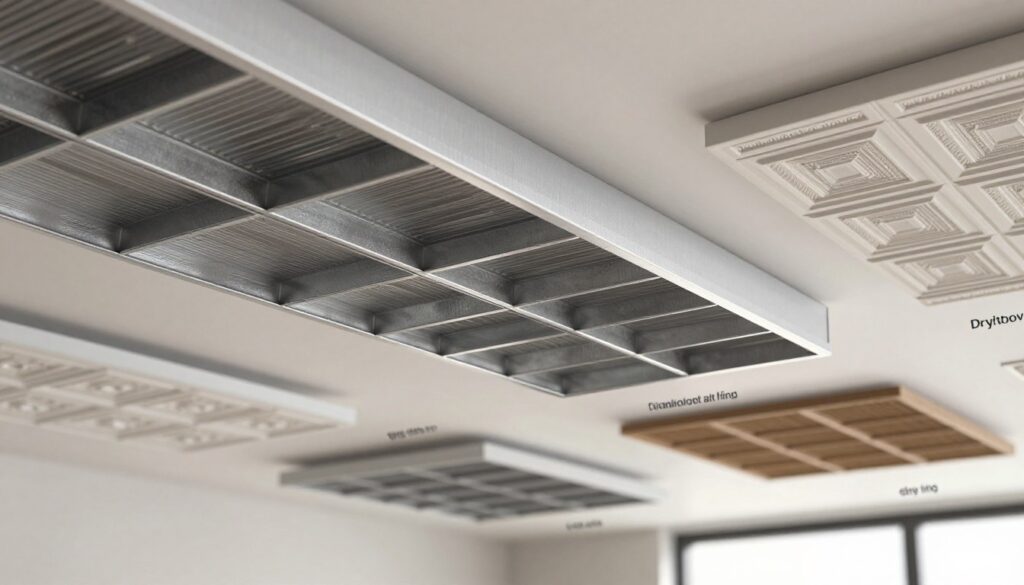
Acoustic ceiling tile (ACT) systems are popular for saving money. They usually get noise reduction ratings of 0.55-0.75. Metal baffles with backing, though, get better ratings of 0.65-0.90.
ACT tiles face durability challenges. They can stain, sag in humid air, and get damaged easily. Metal baffles, on the other hand, last 15+ years without these problems. They also resist moisture and minor damage.
Design is a big difference between these systems. ACT tiles hide the plenum but don’t add much visual interest. Metal baffles, with their lines and depth, can make your space look better. Your design goals decide between these looks.
| Ceiling Type | NRC Rating | Durability | Visual Character | First Cost | Lifecycle Cost |
|---|---|---|---|---|---|
| ACT Systems | 0.55-0.75 | Susceptible to staining and sagging | Full concealment, limited interest | Lower | Higher due to tile replacement |
| Metal Baffles with Backing | 0.65-0.90 | Maintains appearance 15+ years | Dimensional depth and character | Higher initial investment | Minimal maintenance expense |
Costs show ACT is cheaper upfront but more expensive over time. Metal baffles cost more at first but need little upkeep. For projects focusing on cost, ACT is a good choice. But for those willing to invest in better quality, metal baffles offer more value.
Metal Baffles vs. Wood Linear and Drywall Ceilings
Wood linear systems add warmth and texture, great for fancy offices and hotels. They look beautiful but have downsides. Wood needs fire treatment, can warp from moisture, and must be refinished often.
Metal baffles mimic wood’s look but are better at handling moisture and need less upkeep. They offer the look clients want without the constant refinishing costs. Metal surfaces also resist moisture better than wood.
Drywall ceilings are good for smooth, painted looks and matching walls. But, they’re hard to install and need skilled workers. Getting to the plenum for maintenance means cutting and patching walls. They also need extra sound-absorbing materials.
Metal baffles outperform in sound quality and are easier to access for maintenance. They install faster and offer a unique look. They add architectural interest without the need for a plain painted ceiling.
| System Type | Aesthetic Appeal | Moisture Resistance | Maintenance Needs | Installation Speed | Acoustic Performance |
|---|---|---|---|---|---|
| Wood Linear | Organic warmth and richness | Susceptible to warping | Periodic refinishing required | Moderate | Good with treatment |
| Metal Baffles | Wood-grain finishes available | Superior resistance | Minimal maintenance | Fast installation | Excellent, 0.65-0.90 NRC |
| Drywall Ceilings | Clean, monolithic surface | Good moisture resistance | Painting and repair patching | Labor-intensive | Requires additional treatment |
Your choice depends on your project’s needs. Hotels might choose wood for its warmth, offices prefer metal for sound quality, and schools often use drywall for a smooth look. Knowing these differences helps you explain the benefits of metal baffle systems to clients and designers.
Conclusion: Making the Right Metal Baffle Ceiling Decision for Your Project
Metal baffle ceiling systems offer a unique mix of style, sound quality, durability, and eco-friendliness. They are perfect for today’s commercial projects. These systems improve your building’s performance and look. They make workspaces quieter, helping your team focus better and communicate more clearly.
Choosing metal baffle ceilings is a smart long-term investment. They last 15+ years, saving you money on upkeep and replacements. They also let you show off your brand and attract tenants. Plus, they help your building get green certifications, boosting its value.
Start by talking to manufacturers early to customize your ceiling. Ask for samples to check the finish and color. Work with your MEP team to ensure everything works well together. Use the guide’s data to show the benefits of these ceilings. You’re ready to choose metal baffle ceilings for their benefits and value.